
Eames Aluminum Executive Chair: A Chair That Will Outlast Your Career—and Probably Your Next One
In the universe of office seating, most chairs win you over with brute padding or dazzle you with a constellation of levers and knobs. The Eames Aluminum Executive Chair takes a different road—one paved in 1958, with a structural logic so sound that it has quietly absorbed tens of thousands of working hours per sitter, decade after decade.
This is not a chair that makes you gasp on first sight. It is, however, the kind of chair that makes you pause, one year in, with a quiet realization: "I don't think I've ever actually felt uncomfortable in this thing."
This article offers no mystique, no sentimental tributes. Just a thorough, nuts-and-bolts breakdown of its origins, anatomy, configuration choices, and real-world ownership—so you can decide if it's the one that will see you through.
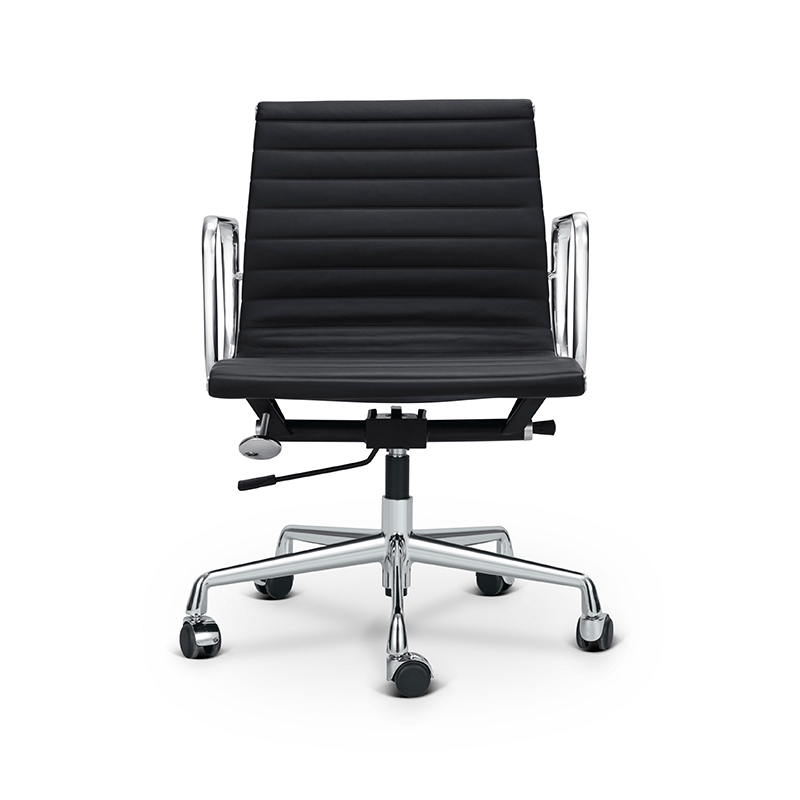
I. Where It Came From: A Birth Story Most People Get Wrong
The common assumption: the Eames Aluminum Group was conceived as an office chair. The truth is far more unexpected.
The year was 1958. Architect Eero Saarinen, then deep in a project, approached Charles and Ray Eames with a peculiar request: design a chair for outdoor use—one that could withstand sun, rain, and the elements, while remaining genuinely comfortable.
The Eameses responded with a deceptively simple engineering gambit: build a lightweight aluminum exoskeleton, then suspend the seat and backrest between its frames like a taut hammock. The result required no thick foam, no complex springs—just the tensile strength of fabric or leather stretched across a ribbed structure. They called it the suspended seat system, and it became the irreducible DNA of the entire Aluminum Group.
The ironic twist? The design proved so brilliant for indoor work—breathable, supportive, non-sweaty, and effortlessly ergonomic—that Herman Miller formally adopted it into their office furniture line later that very year. Thus, the Aluminum Executive Chair was born.
Think of it this way: it's an outdoor chair in a business suit—an engineer's solution dressed for the boardroom.
II. Why It Feels So Good: Three Non-Negotiable Design Principles
Comfort is subjective, but the Eames chair's comfort is measurable—anchored in three clear engineering choices.
1. The Suspended Seat: The Chair Catches You
Conventional office chairs rely on thick foam or molded polyurethane. You sink in initially, but over hours, the foam compresses, your hips drop, and your lumbar spine loses its support curve.
The Aluminum Group does the opposite. Its seat and back are a single, continuous panel of taut material—leather, mesh, or fabric—stretched across aluminum "ribs." When you sit, the panel deflects slightly under your weight, cradling your glutes and thighs in a custom curve. This is not pushing against you; it's catching you—like a hammock's physics, but with far higher tension, giving resilience without wobble.
2. The Aluminum Rib Chassis: Stiff Where It Must Be, Supple Where It Counts
The backrest comprises multiple horizontal aluminum ribs. Most assume this is purely aesthetic. It is not.
These ribs are not rigid beams; they possess controlled torsional flex. When you recline, each rib twists microscopically to conform to your scapulae and spinal curve. Sit upright, and they spring back to their neutral geometry. This local flexibility within a globally rigid frame is achieved through cast aluminum and precision stamping—not through upholstery tricks.
3. Minimal Adjustments, Maximum Essentiality
Compared to today's hyper-adjustable ergonomic monsters—with seven levers, sliding lumbar pads, and tilt-lock tension dials—the Eames Executive Chair is almost ascetic. It offers only pneumatic height adjustment and 360° swivel (standard on the Executive high-back model).
Is it "less ergonomic"? Consider an alternative view: truly good support requires no constant fiddling. The chair's fixed geometry and suspension tension are calibrated to accommodate most body types in a neutral, upright posture. If you habitually slouch or sit cross-legged, this chair will punish you—it was designed to encourage good sitting, not accommodate bad habits.
III. Which Configuration: A Practical Buyer's Guide
The Eames Aluminum Executive Chair is not a single product but a family built on a shared chassis. Here are the real-world choices you need to make.
Size: Executive vs. Management
Two primary sizes exist:
-
Executive (High-Back): Taller backrest, covering the mid-to-upper scapulae. Provides fuller upper-body support. Recommended for heights above 175 cm (5'9") or anyone sitting 4+ hours daily.
-
Management (Low-Back): Shorter back, visually lighter. Suited for average-to-smaller frames (below 170 cm / 5'7") or compact home-office setups.
The rule: If you sit over four hours a day, choose Executive. That extra back height makes a cumulative difference over years.
Upholstery: Leather, Mesh, or Fabric?
This is the single most consequential decision—and there is no universal "best."
| Material | Pros | Cons |
|---|---|---|
| Leather | Supple feel, ages beautifully with patina, most "classic" aesthetic. | Warmer in summer (requires AC); needs periodic conditioning. |
| Mesh | Most breathable—ideal for warm climates or non-AC spaces; modern, minimalist look. | Less tactile warmth; cooler to the touch in winter. |
| Fabric | Soft texture, wide color range, good breathability. | Harder to clean; stains and spills absorb easily. |
My take: If your room is climate-controlled and you value tactility, choose leather. If you run warm or have no AC, choose mesh. Fabric sits in the middle—only if you're certain about spill-proof habits.
Base: Casters vs. Glides
This is often overlooked but has major real-world impact.
-
Casters: Essential for mobility—workstations, conference rooms. But type matters: hard casters for carpets; soft rubber casters for hardwood, tile, or marble. If you have wood floors, insist on soft casters—or watch your floor accumulate scratch scars within days.
-
Fixed Glides: If your chair stays put (e.g., a dedicated reading spot), glides offer superior stability and zero floor damage. They are smooth rubber/plastic pads that don't roll or wobble.
- Height Range and Armrests: The Underrated Details
-
Pneumatic cylinder: The Executive model's lift range is typically 15–20 cm (6–8 inches), suited for standard desk heights (72–75 cm / 28–29.5"). If you use a standing desk or bar-height table, verify the cylinder's travel range.
-
Armrests: They are fixed—no height, angle, or depth adjustments. They are sculpted to fit the average adult's natural arm position while typing. If you're accustomed to resting your elbows high, you'll need to adapt. However, if you type with floating arms (as many do), this feature becomes irrelevant.
IV. Where It Belongs: Ideal Use Cases
This chair has endured for six decades not because it's pretty, but because its versatility is remarkable.
Home Office / Study Its restrained elegance doesn't scream "gamer" or "budget special." It harmonizes with modern, mid-century, or industrial interiors—alongside wooden desks, bookshelves, or architect's lamps.
Corporate Executive Suite In professional settings, this chair is a silent credential. It doesn't shout wealth like a gilded "boss chair," but those in the know recognize it instantly. It signals: I have taste, but I don't need to flaunt it. That's why you'll find it in partner offices at law firms, design studios, and financial houses.
Conference Rooms & Reception Areas The high-back Executive works beautifully at the head of a conference table or as a statement single seat. Its back angle promotes a conversational posture—neither slumped nor rigidly upright.
Display & Styling A niche but genuine use: showrooms, concept stores, and photo sets. Its side profile—the rhythmic aluminum ribs—is photogenic from any angle. This is bonus utility, not the primary draw, but worth noting.
V. Maintenance: Minimal Effort, Maximum Longevity
Worried about leather and aluminum? Here's the straightforward reality.
Aluminum Frame Cleaning Oils from hands and clothing accumulate over time, dulling the finish.
- Use a soft cloth with mild glass cleaner (ammonia-free).
-
Wipe the frame, then dry with a second clean cloth to avoid water spots.
-
Never use steel wool or abrasive pads—they'll scratch the anodized surface. A two-minute wipe once a month suffices.
Leather Upholstery Care Two cardinal rules: avoid sunlight and condition periodically.
Sunlight: UV rays crack and fade leather. If unavoidable, use sheer curtains or UV-blocking film on windows.
Conditioning: Apply a dedicated leather cream or oil every 3–4 months. Wipe on, let absorb, buff lightly. Over-conditioning makes the surface tacky—less is more.
Mesh Upholstery Care The lowest-maintenance option:
-
Vacuum with a brush attachment to remove dust and dead skin from crevices.
-
For stains, dab with a damp cloth and mild dish soap, rinse with clean water, blot dry.
-
Avoid bleach or solvent-based cleaners—they degrade synthetic fibers.
Pneumatic Cylinder & Casters
-
Cylinder: virtually maintenance-free. If it squeaks or sticks, clean dust off the shaft with a dry cloth.
-
Casters: hair and lint will wrap around axles over time. Flip the chair periodically, trim off debris with scissors—restores smooth rolling instantly. For soft casters on hardwood, occasionally check for embedded grit (small stones) that can scratch floors.
VI. Minor Curiosities You Might Actually Wonder About
How much does it weigh? The Executive high-back weighs approximately 18 kg (40 lbs). That's light for an all-metal-frame chair—easy to drag or reposition—yet heavy enough to stay planted when you lean back.
Can the seat cushion be replaced separately? Yes. The seat and back panels are screw-mounted to the frame. After years of wear, you can order a replacement upholstered panel—no need to scrap the entire chair. That's durability by design, not accident.
What height range does it truly fit? The Executive model accommodates users from roughly 165 cm to 185 cm (5'5" to 6'1") comfortably.
-
Under 160 cm (5'3"): the lumbar point may sit too high; you'll need a footrest.
-
Over 190 cm (6'3"): your shoulders may exceed the backrest—consider custom sizing or a different high-back model.
Can you add a headrest? No original headrest exists, and aftermarket additions are strongly discouraged. The back's curvature and suspension tension are calibrated for head-free sitting. Adding a headrest disrupts the balance and creates unnatural pressure on the neck. If you require neck support, this chair is likely the wrong fit for you.
The Eames Aluminum Executive Chair is not a "perfect" chair—it lacks the flood of adjustments and the dramatic silhouette of trendier seating. But it is a chair that rarely, if ever, draws a complaint.
You won't feel a moment of revelation when you first sit. But after one, two, three years—when you notice it hasn't sagged, squeaked, or loosened—you'll understand its quiet brilliance. It delivers, hour after hour, with no fanfare and no fatigue.
You buy a chair like this not to impress your social feed, but because your body will spend thousands of hours on it—and you'd rather it didn't protest. In that single, unglamorous measure, the Eames Aluminum Executive Chair succeeds utterly.
Previous:No News
Send Inquiry



X
We use cookies to offer you a better browsing experience, analyze site traffic and personalize content. By using this site, you agree to our use of cookies.
Privacy Policy